Rooting Childhood in Nature – Supporting Children’s Health, Caring for Our Home in the Universe
On October 22, 2025 NLI hosted its 18th Design Institute, a milestone event celebrating the global children and nature movement and 25 years of NLI’s work in advancing healthy childhoods through biophilic free play and learning, driven by design research, education, resource dissemination, and multimedia communication. The day brought together designers, educators, researchers, and advocates to reflect on progress, share insights, and look ahead to the next generation of child-friendly, nature-rich environments.
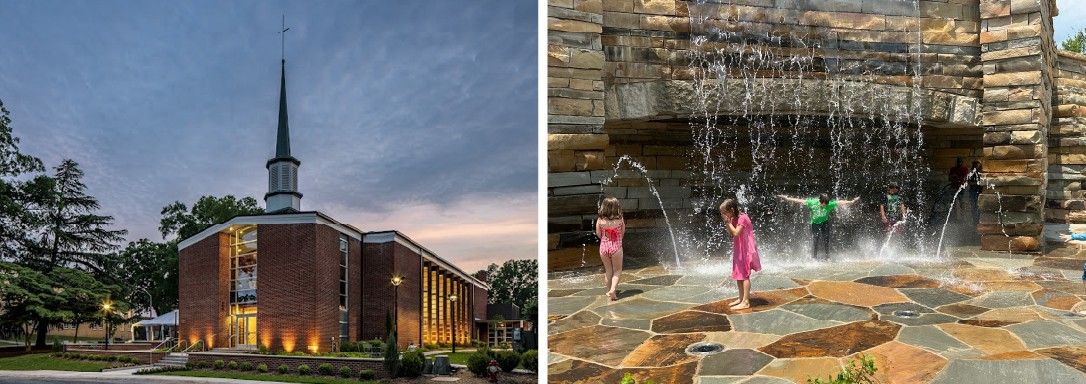
The main event was held at the Greg Poole Jr. All-Faiths Chapel at Dix Park, Raleigh, NC with a trip to Gipson Play Plaza for lunch!
Watch the Rooting Childhood in Nature webinar presentations – refined versions of those originally delivered at the institute.
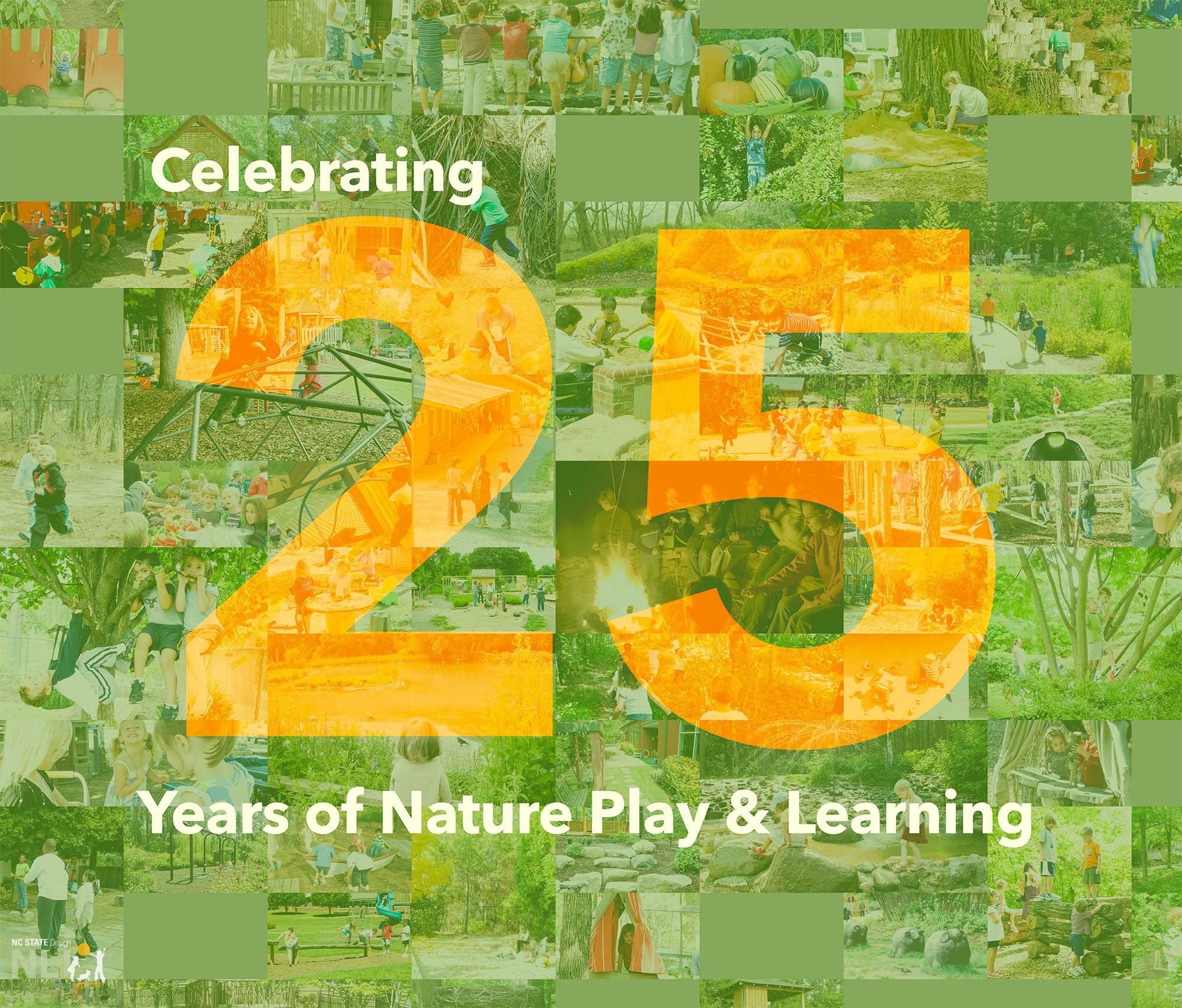
25th Anniversary NLI Exhibition – Discover 25 years of impact through community co-design, research, education, professional development, resource creation, & communication!
Brooks Hall Gallery, College of Design, NC State University
Event Highlights
Mark Hoversten, PhD, Dean, College of Design, NC State University, welcomes participants.
“Love it or Lose it” created by Bailey Lawson in a freshman GXD studio taught by Victoria Chi, assisted by Matt Babb.
Matt Urbanski discusses Gipson Play Plaza Design. Filmed by Tim Beatley.
Richard “Rich” Louv, author of Last Child in the Woods, shares thoughts about NLI and the future direction of the children & nature movement.
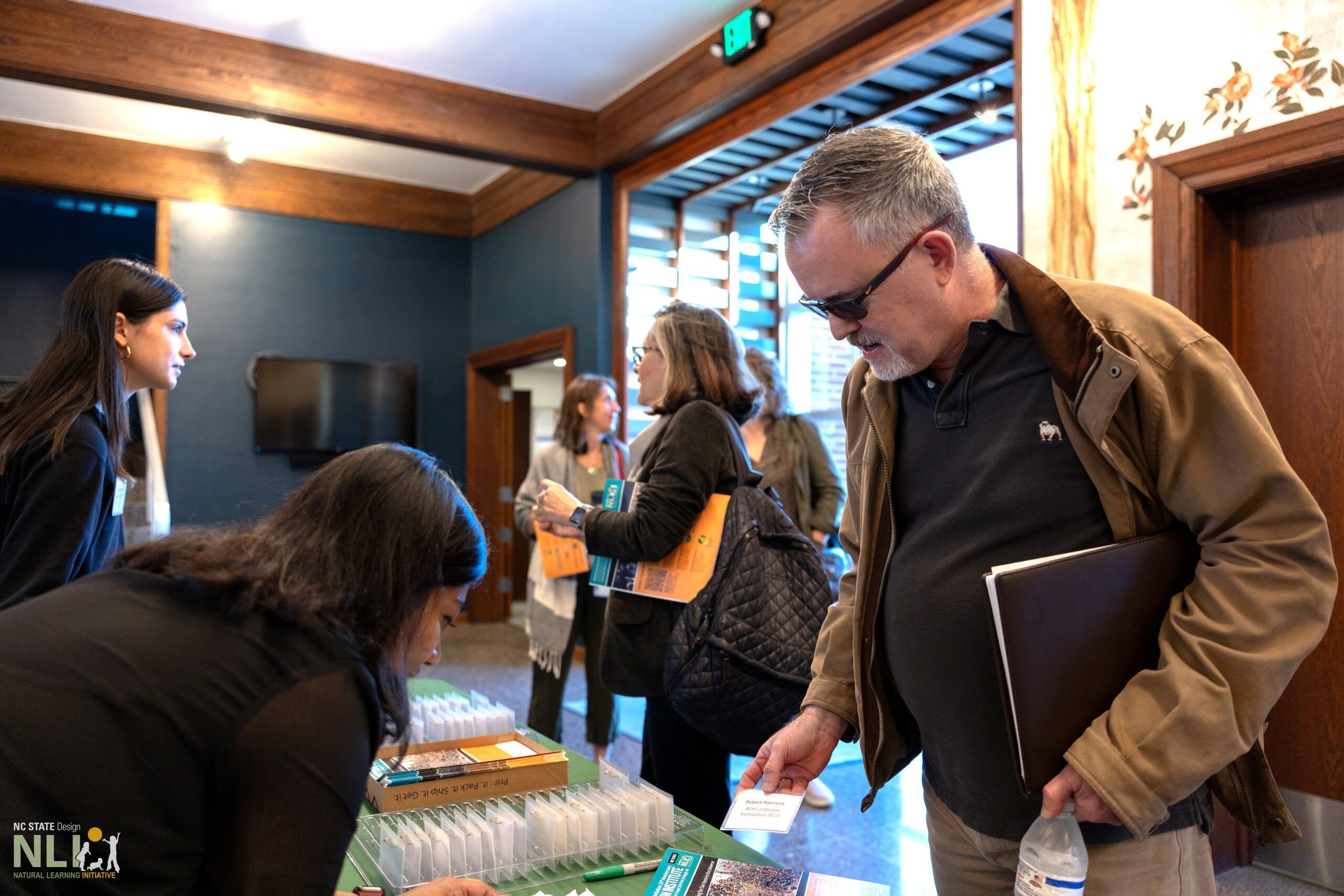
Landscape Architect Rob Harrison eagerly checks in.
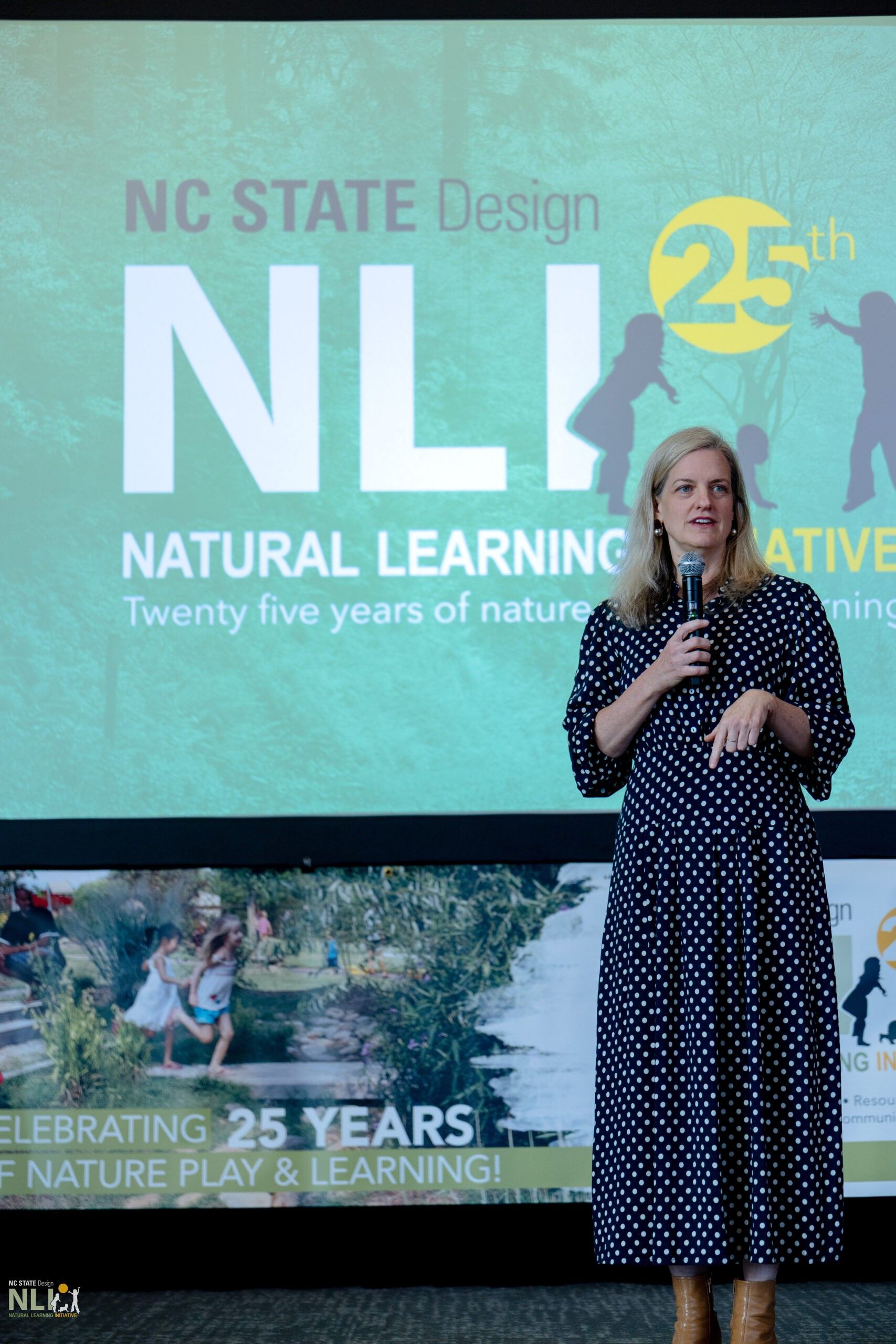
On behalf of the City of Raleigh, Mayor Janet Cowell welcomes the audience to Dix Park.
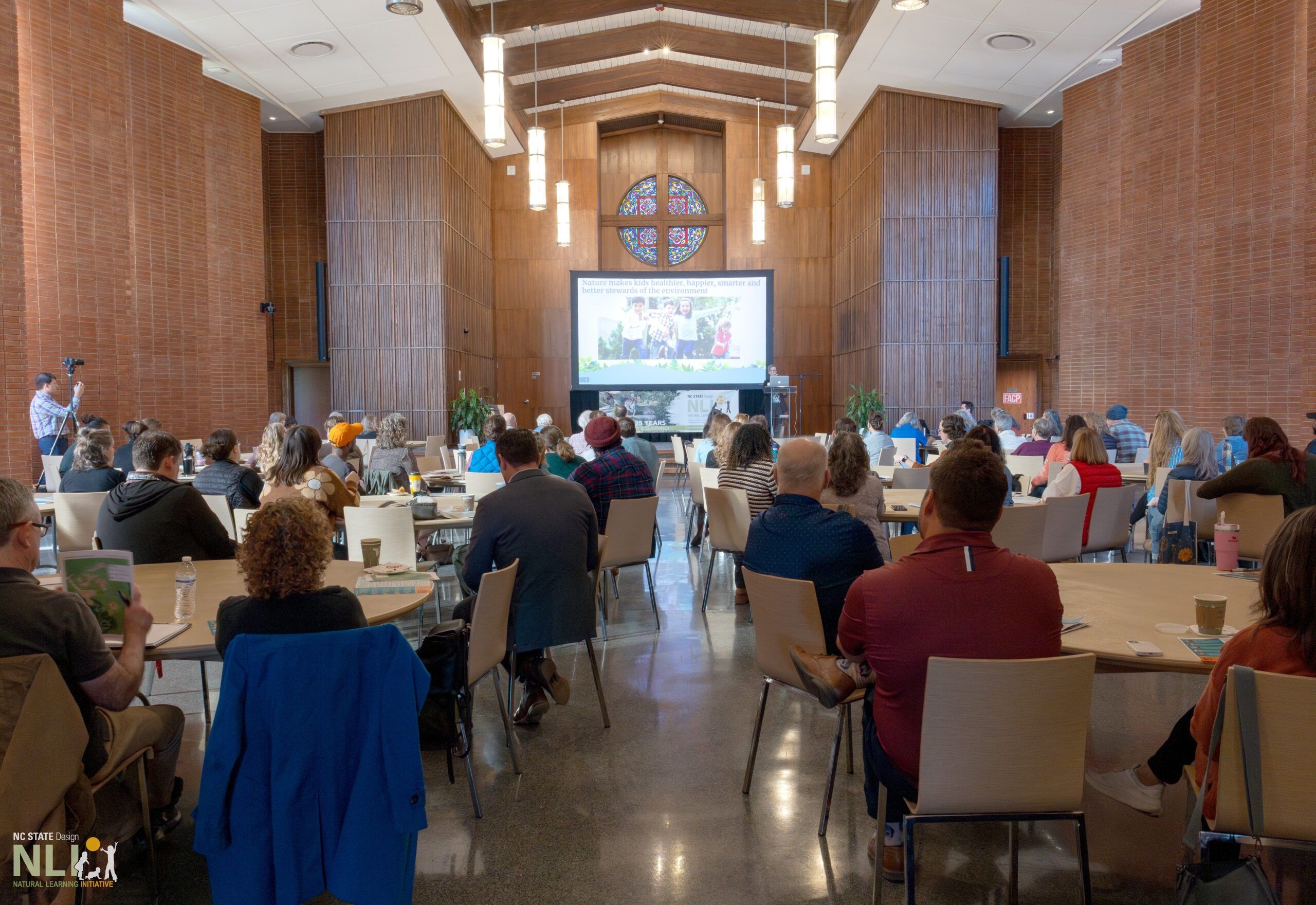
The Greg Poole Jr. Chapels’ outstanding, contemporary nave arches over the 130+ participants.
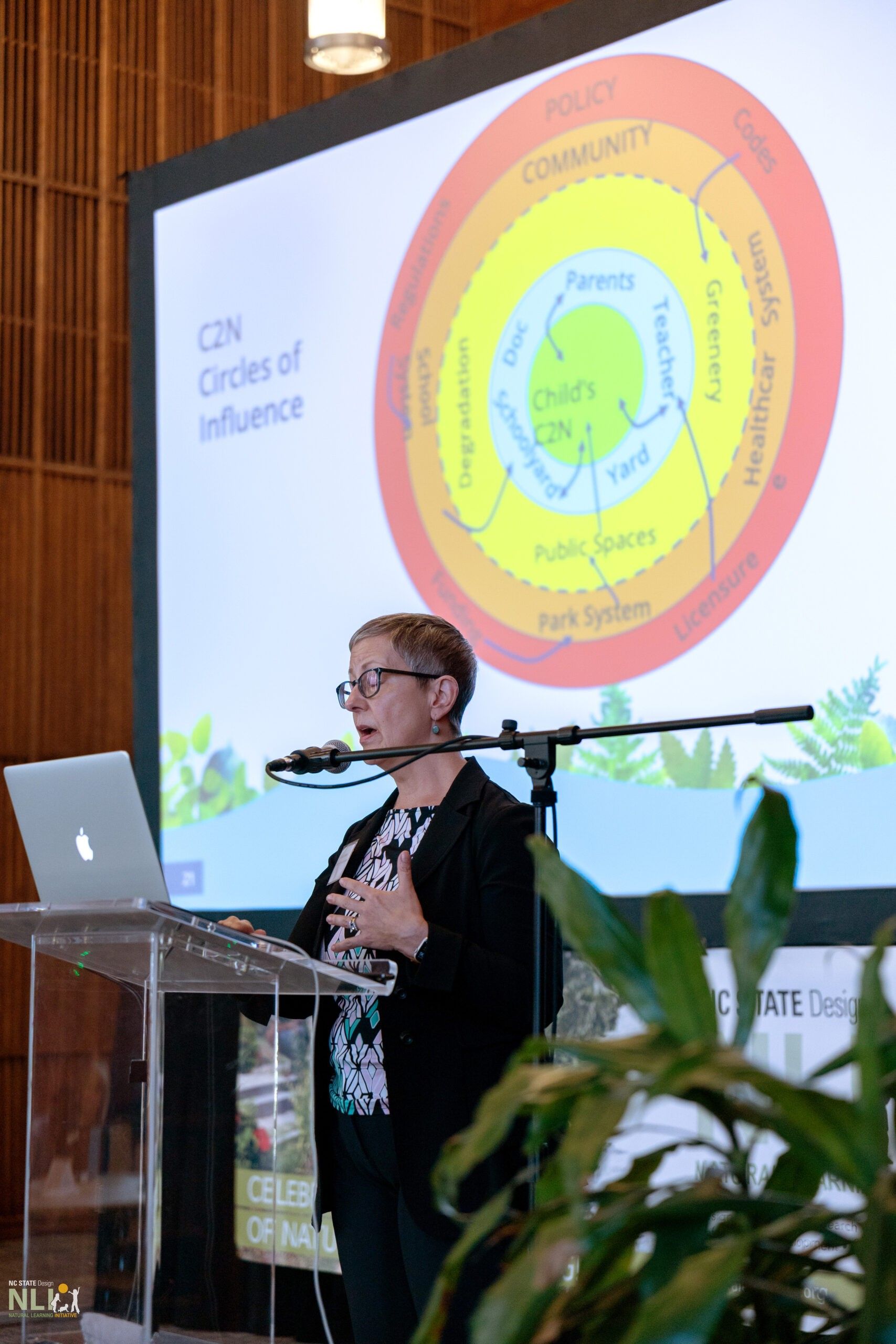
Opening speaker Cathy Jordan presents “What the Evidence Tells Us” about Children & Nature.
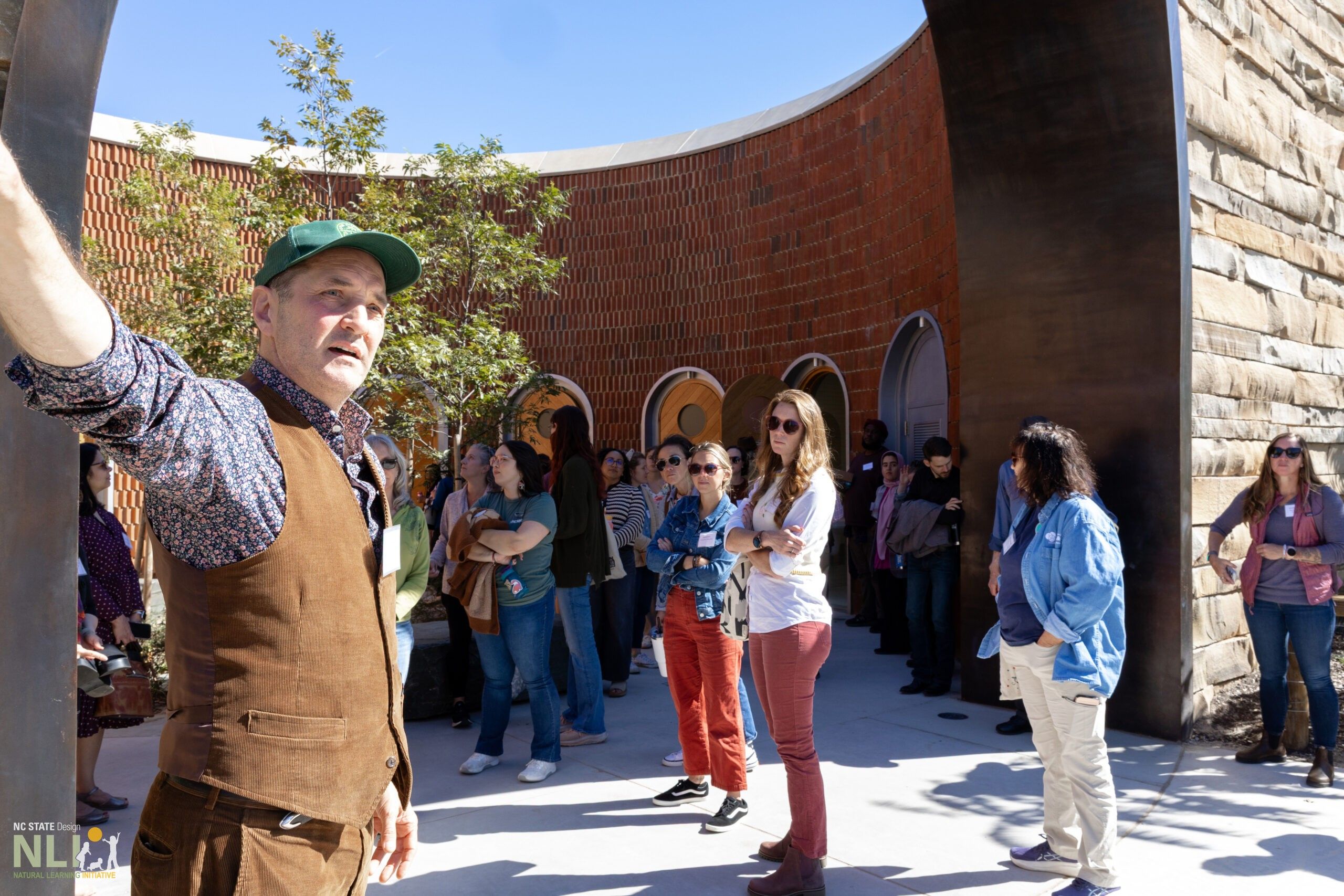
Speaker Matt Urbanski, Lead Designer of Gipson Play Plaza, describes the unique restroom courtyard.
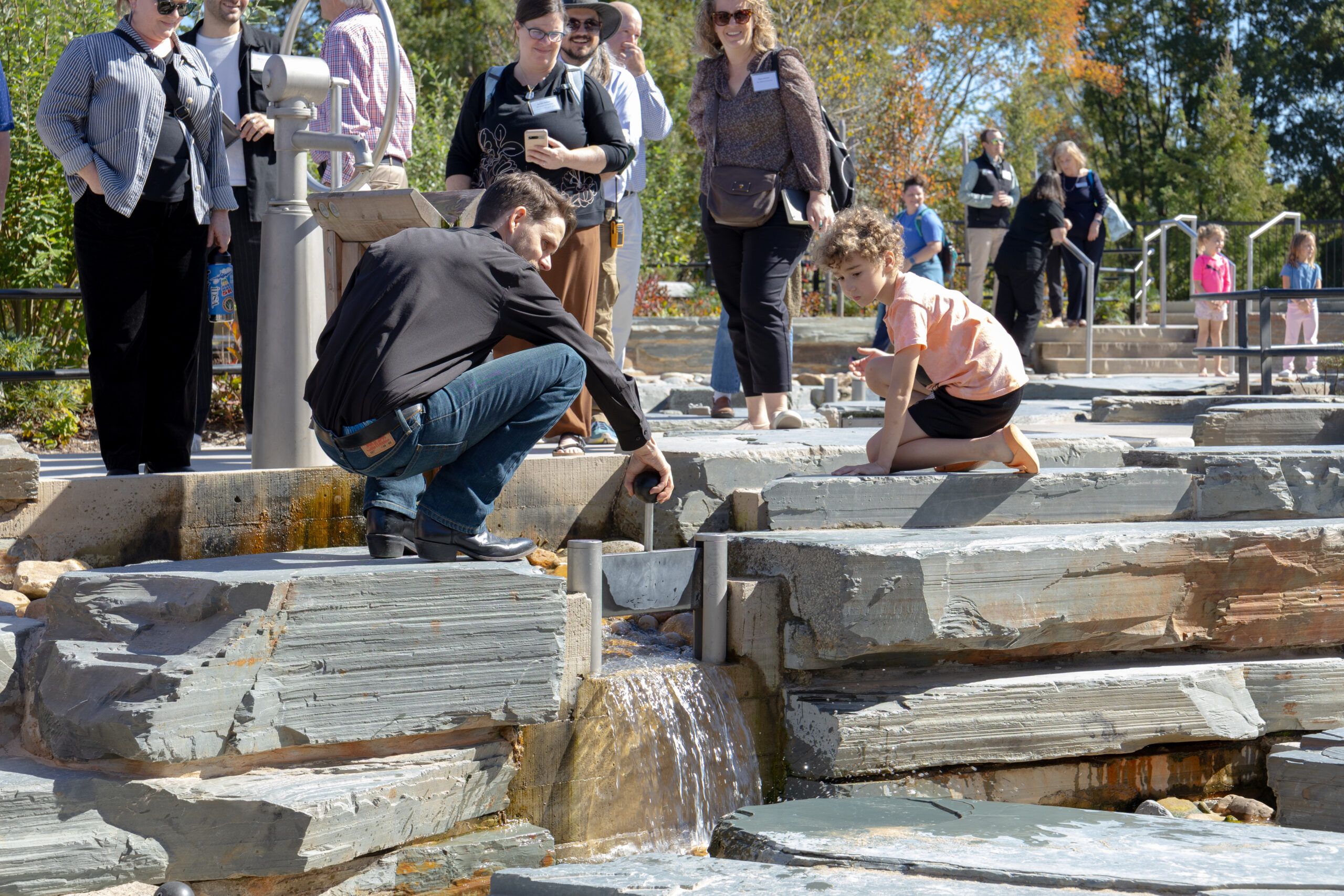
Watermill Mountain, predictably the most popular play and learning setting.
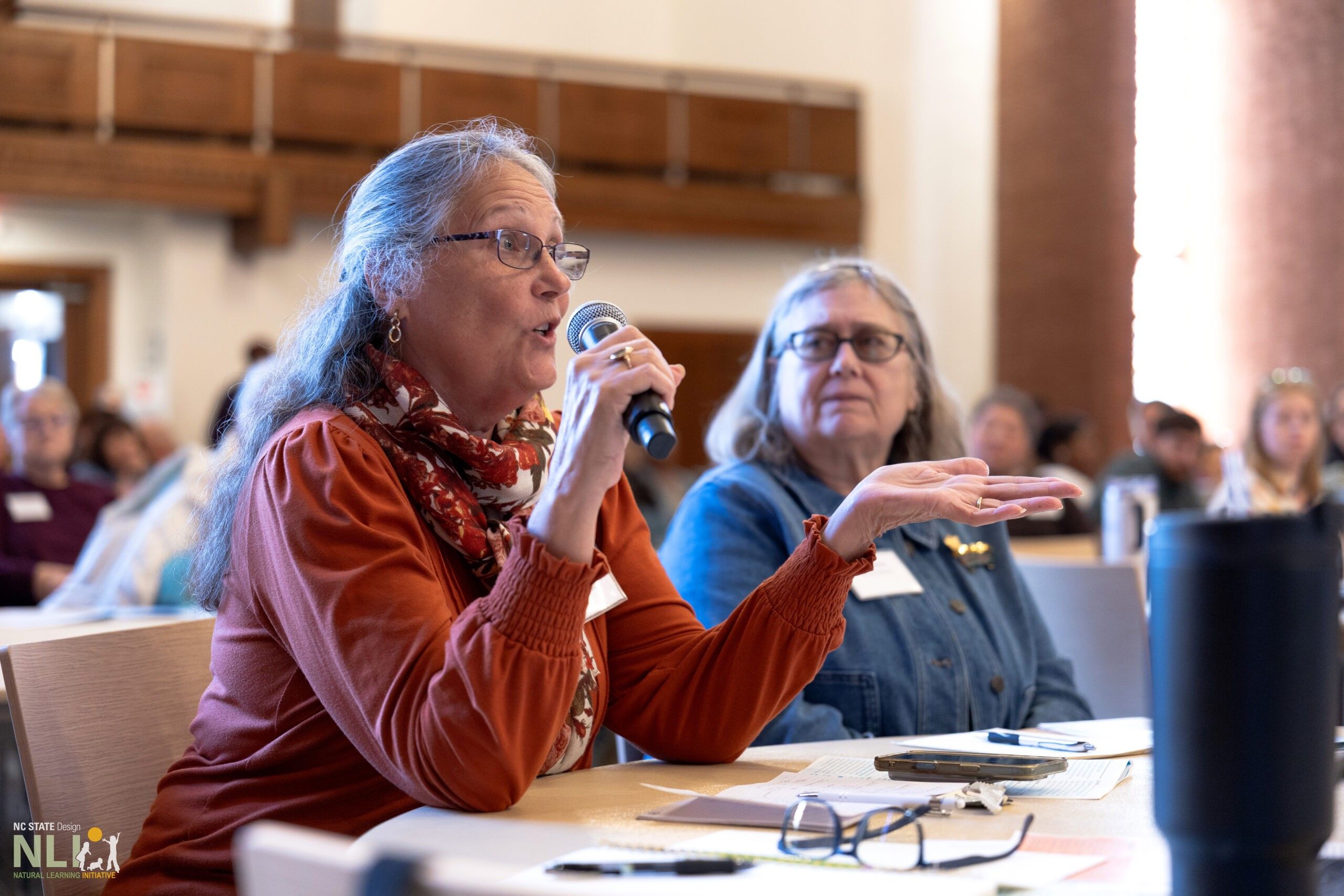
Rhonda Hawkins responds to the “way ahead” question posed to the panel and participants.
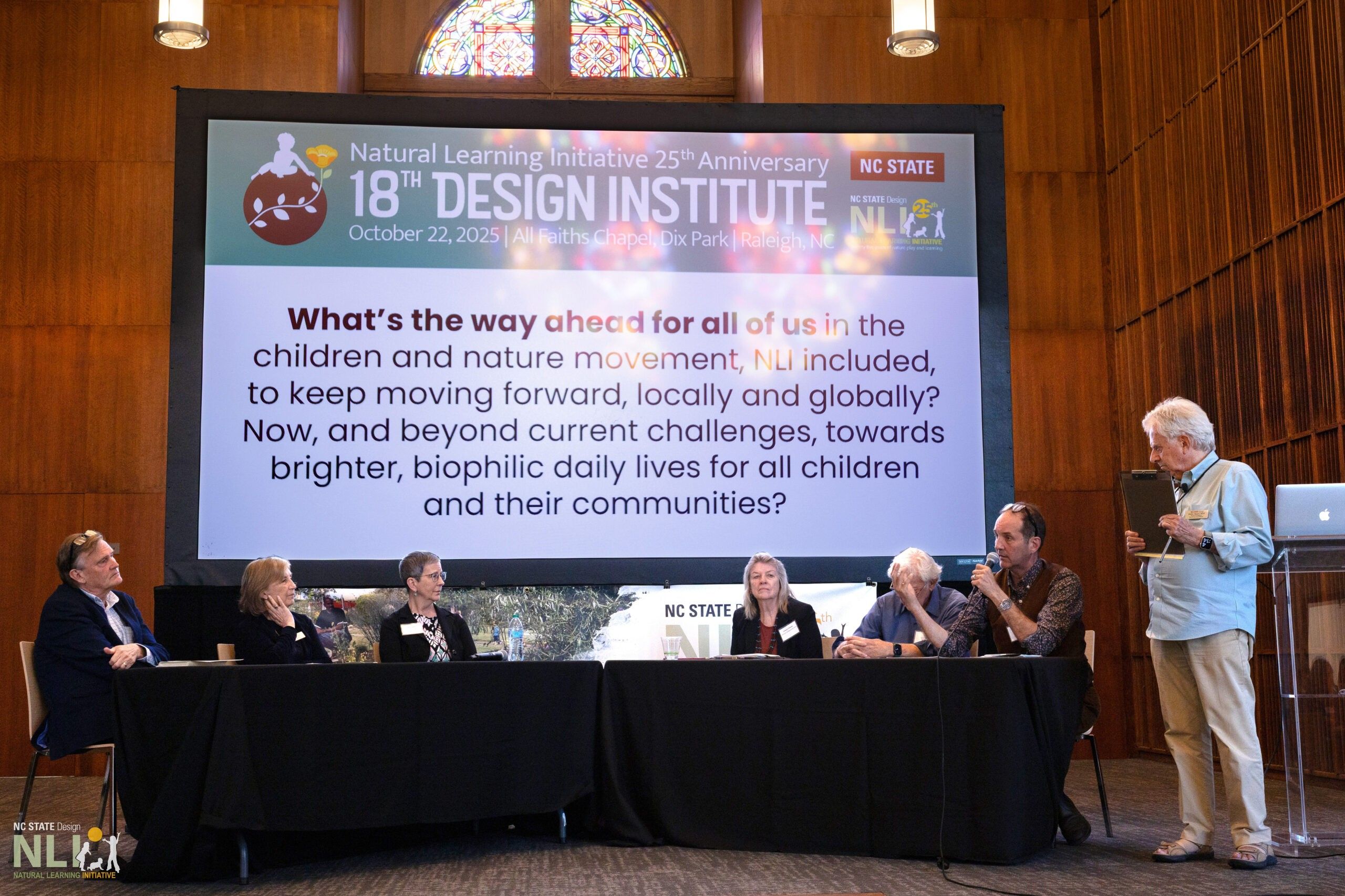
The panel, facilitated by Robin Moore (right), responds to the “way ahead” question with a plethora of ideas.
The Way Ahead
Children and Nature Movement Priorities
Here, the NLI 18th Design Institute (October 22, 2025), closing panel conclusions and audience comments and reflections, are presented as a unified action plan. Emphasized is a central message from both reports:
The movement must evolve from advocating for children's access to nature toward systematically creating the conditions that make nature-connected childhoods possible—every day, everywhere.
Practical implementation priorities start with everyday neighborhood access and children's freedom to roam and play, followed by policy reform, professional capacity building, creating demonstration projects, and cross-sector collaboration.
The Challenge
The Children and Nature Movement has established a compelling vision of nature-rich childhoods, supported by growing research, professional practice, and grassroots engagement. The challenge now is to translate that vision into sustained, systemic change. This requires a shift from advocating for nature access to enabling daily, equitable, lifelong nature connectedness through changes in physical environments, institutional practices, public policy, and cultural expectations.
- Make Everyday Nature Access a Universal Priority
Shift from destination-based experiences to nature embedded in daily life. Prioritize walkable neighborhoods, naturalized childcare centers, schools, residential landscapes, streets, and community spaces. Promote small, affordable interventions—trees, gardens, play streets, loose parts, and naturalized outdoor environments—that can spread through local adaptation.
Action: Develop replicable neighborhood-scale childcare and school models, and practical implementation resources, prioritizing communities with limited access to nature. - Restore Children's Freedom to Roam and Play Outdoors
Challenge with compelling data, the culture of fear, excessive supervision, and risk aversion. Protect children's opportunities for self-directed exploration, spontaneous play, manageable risk, and independent mobility. Rebuild parental and community confidence in children's capacity to play freely. Promote “ped-bike” residential street design.
Action: Advance supportive policies, including residential site design, and practical models, including micro play spaces, supervised open-play sessions, and trained nature lifeguards who safeguard opportunities for nature play without directing it. - Move from Advocacy to Policy and Institutional Change
Embed nature-connected childhoods in the systems shaping children's daily lives. Integrate outdoor playful learning into childcare licensing, quality improvement systems, educational practices, public health, urban and transportation design, and park design policy.
Action: Identify high-impact policy opportunities, mobilize coordinated advocacy, and establish measurable expectations for everyday outdoor access and environmental quality. Participate in the review boards that influence policy. - Build Professional and Community Capacity
Equip those who shape children's everyday environments. Expand professional development for educators, childcare providers, landscape professionals, administrators, and community leaders. Emphasize nature-based playful learning, facilitation rather than control, and practical landscape improvement.
Action: Develop accessible training, micro-credentials, implementation guides, and peer-learning networks, including community college pathways and nature-play facilitation programs. - Demonstrate, Replicate, and Scale Effective Models
Make the vision visible and achievable. Develop exemplary nature-rich environments that inspire public investment and demonstrate the benefits of biophilic communities. Complement flagship projects with affordable, locally adaptable models that encourage widespread replication.
Action: Establish demonstration networks linking flagship sites with childcare centers, schools, neighborhoods, and community organizations. Document costs, implementation processes, outcomes, and lessons learned. - Mobilize Cross-Sector Partnerships and Investment
Position nature connectedness as a multi-solution strategy. Connect children's development and well-being with public health, education, biodiversity, climate resilience, social equity, and urban livability. Build alliances beyond the movement's traditional professional networks.
Action: Convene partnerships among government, education, healthcare, planning, environmental organizations, business, and philanthropy to support coordinated local implementation and sustained investment.
- Strengthen Research, Evidence, and Accountability
Connect research directly to implementation and policy. Integrate interdisciplinary evidence with evaluation of environmental quality, children's behavior, developmental outcomes, and sustained nature connectedness.
Action: Establish shared indicators, evaluate demonstration projects, document implementation costs and benefits, and translate findings into practical guidance for decision-makers and communities. Emphasise Social Return on Investment (SROI).
- Build an Inclusive, Intergenerational, Global Movement
Make nature connectedness a shared cultural commitment across generations. Engage parents, grandparents, educators, and communities in rebuilding everyday relationships with nature. Extend collaboration to rapidly urbanizing and resource-constrained regions where children's access to nature is increasingly threatened.
Action: Support family nature programs, intergenerational landscapes, grassroots networks, and international knowledge exchange, emphasizing locally led approaches adaptable to different cultural and economic contexts.
- Communicate Hope, Courage, and Collective Responsibility
Move beyond awareness toward a compelling culture of action. Counter fear, pessimism, and fragmentation with an affirmative vision of joyful, nature-connected communities. Celebrate incremental progress while sustaining ambitious long-term goals.
Action: Develop a shared communication strategy that combines evidence, compelling stories, practical opportunities for participation, and visible examples of successful change.
In Summary
The next phase of the Children and Nature Movement must be defined by implementation, institutional change, and measurable expansion of everyday nature connectedness.
The ultimate objective must move beyond creating opportunities to visit nature, to reintegrate children, families, and communities into the living ecosystems of everyday life – locally, globally, and across generations. Think globally, act locally, transform systems that enable children everywhere to play and learn freely and grow connected to nature across the lifespan.
NLI will continue to advance the movement priorities by expanding and applying NLI’s established strengths in research, landscape design, professional development, policy engagement, and implementation support.
Opportunities include codifying replicable nature-play and learning environments; strengthening outdoor quality assessment; developing professional training and credentials; evaluating demonstration projects; and building cross-sector partnerships capable of accelerating implementation – particularly the landscape contracting industry.
"Blessing"
- A poem by Jesse Turner, PLA
I'm from Transylvania County and I brought my daddy with me. I brought the rocks I tiptoed across the creek on, half rotten logs I sat alone in the woods on, water spiders, lightning lizards, summer rain, messy hair, and chaos - a child from wild places.
You sat with me, and I was a long-shot. I needed a place where my memories hold value in foreign geographies, and you said yes.
We dreamt of saving earth, together in a basement under the stairs. I was wild as hell, and wanted to break from my skin every morning but by noon I was a little softer. You were the admiral, and she was the mother. We had dreadlocks, attitudes, dissertations, and a coffee pot. This was our safe place where we gathered over layers of yellow and creamy white trace paper.
It was a vibe.
There were old light tables, micron pens, mechanical pencils, crumpled papers, binder clips, easels, flip charts, xerox copies, filing cabinets, drafting dots, little Argentine sayings, moot points, doohickies, thingamabobs, and books made for grown ups to find what they don’t want to lose. We talked about risky things like the liability of a stone and growing tomatoes.
We counted the affordances of low hanging fruits, the behaviors of souls huddled in shade, little feet stomping down pathways, and we captured them with dots on pages with our clip boards and uniball pens.
We counted the places where babies grow up under the supervision of licensed professionals, like farmers preparing to plow fields in the spring, waiting for the frost to break so our seeds could begin to grow.
We were rebels in a dance we created together.
In this little shelter for freedom where a bare light bulb glows in the darkness our friends came to join us like moths looking for the full moon and you taught them the steps.
In this little room with walls made from shelves, we discussed life on earth and what learning to walk means. Territorial ranges expanded as we grew, we chose our paths and picked blueberries from the ceiling of our special hut.
We started to fly.
Living systems connect us from oceans to mountains, between landscapes and cities we grow up in. With wings spread and facing horizons, we tossed intention in the sky and listened for an echo. Each sketch a hopeful whisper, a shared dream, a reverberation of a paperback book and a voice tumbling through time bouncing off canyons to land between the fat toes of babies lying on soft grass watching the flowers wave in a breeze that carries images like blown seeds back to us. The evidence we wait for in those echoes we hope for returns with each first step taken, with each first word spoken. Generations emerge from this chrysalis where we draw circular paths, touch gentle memories, and make wild again what had fallen into ordinary.
This is what it feels like to spread joy.
Did you bring the rocks you tiptoed across the creek on, those moss covered logs you sat on, or the stick you found for your friend? Bring them here to this altar and let them breathe among the rest of us, to this place we made for each other in this field built by grandchildren.
What do we want?
We want earth filled with warmth and comfort, the eyes of loving friends upon us, and sweet mischief at the prospect of life beginning over and over again. We want that for humanity. We want peace, love sweet and tender, and we want a belly full of it.
The last child in the woods won’t be born to us.
We are alive and this is our blessing.

Listen along (with intro)
Audio recording opens with Jesse’s “wild child” memories of Transylvania County nature that informed his undergraduate work at NLI 25 years ago!
Program
9:00 am
OPENING REMARKS
Robin Moore, DipArch, MCP, Hon.ASLA, Co-founder & Director Emeritus, NLI; Research Professor & Professor Emeritus, Department of Landscape Architecture and Environmental Planning, NC State University.
Nilda Cosco, PhD, ASLA, Co-founder & Director of Programs, NLI; Research Professor, Department of Landscape Architecture and Environmental Planning, NC State University.
9:05 am
WELCOME!
25 years ago, a few grown-up kids with an ambitious dream took a chance—and Dean Marvin Malecha said “yes.”
We’re pleased to introduce several individuals with special connections to the 25th Anniversary Celebration: Rooting Childhood in Nature.
Rebecca Quinn-Wolf, SVP & Director of Client & Community Relations, PNC (Primary sponsor).
Janet Cowell, Mayor, City of Raleigh.
Kate Pearce, Executive Director, Dix Park, City of Raleigh.
Rob Maddrey, Vice President of Development, Dix Park Conservancy.
Mark Hoversten, PhD, Dean, College of Design, NC State University.
Maria Bellalta, Head, Department of Landscape Architecture and Environmental Planning, NC State University.
Soolyeon Cho, PhD, Assoc. Dean for Research, College of Design, Interim Director, NLI.
9:30 am
Rooting Childhood in Nature (NLI YouTube Short)
9:45 am

What the Evidence Tells Us. What do we know about children’s engagement with nature—why it matters, when it’s most critical, where it should occur, and in what dosage? Who ensures that these opportunities for interaction exist? What links are missing in the “nature supply chain”?
Cathy Jordan, PhD, is Director of Research, Children & Nature Network; Professor of Pediatrics, University of Minnesota; and Cofounder and Co-leader, Teacher Field School. She specializes in the impact of the physical environment on children’s health, wellness, academic success, and care for the Earth.
10:30 am
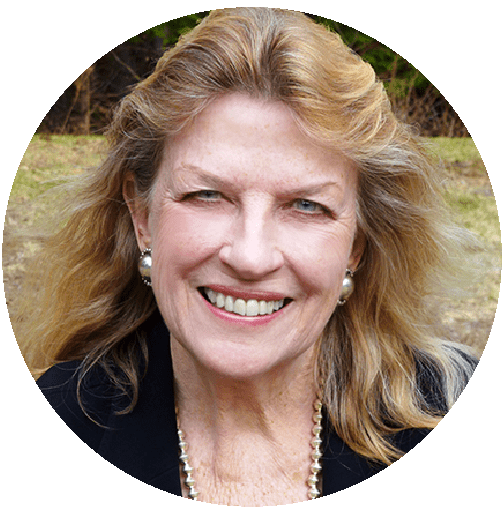
Global Action. The child’s right to nature—now gaining international recognition—nurtures GenN, the next generation of nature advocates. The IUCN’s Nature-Based Solutions (NbS) framework advances this vision as an equitable people–environment design tool.
Cheryl Charles, PhD, is co-founder of the Children & Nature Network, works with the IUCN Commission on Education and Communications, and is Chair of a Vermont School Board.
11:15 am

The Forces That Have Brought Kids Indoors, and How We Can Get Them Out Again. Over the past 75 years, multiple societal forces have combined to limit children’s free play, independence, and outdoor freedom. What are these forces—and what movements are countering them? If we want children outdoors more, we must give them the freedom to play outside with peers, without adult interference. That is the challenge.
Peter Gray, PhD, is Research Professor of Psychology and Neuroscience, Boston College. He is an expert in children’s play and informal learning and author of Free to Learn and other provocative books addressing contemporary childhood.
12:00 pm
LUNCH & EXPLORING GIPSON PLAY PLAZA (GPP)
Robin Moore and Kate Pearce brief and introduce Matthew “Matt” Urbanski, MVVA, Gipson Play Plaza
lead designer and Chelsea Hoffman, APE Studio, NYC/Richter Spielgeräte, Frasdorf, Germany. Kate Pearce highlights key “don’t miss” points of interest around Gipson Play Plaza.
2:00 pm

Achieving Nature Play and Learning On and In the Ground. For over 25 years, MVVA partners Matt Urbanski and Michael Van Valkenburgh have invited NLI to collaborate on projects supporting children and families. MVVA’s portfolio shows expertise in the field of landscape architecture as a health-promoting intervention. In this presentation, Matt will share MVVA’s evolving approach to designing for free play, including Gipson Play Plaza.
Matt Urbanski, FASLA, is a partner in Michael Van Valkenburgh and Associates (MVVA), landscape architects, NYC, and lead designer of Gipson Play Plaza.
3:00 pm

Creating Biophilic Cities in Favor of Children and Families. Case studies from the Biophilic Cities Network will explore strategic approaches across climate, culture, partnerships, policy, and politics. The session will highlight keys to success, methods of measuring impact, and lessons that may inform Raleigh’s role as a Biophilic Cities Network member.
Timothy “Tim” Beatley, PhD, is the Teresa Heinz Professor of Sustainable Communities, Department of Urban and Environmental Planning, School of Architecture, University of Virginia. He is an author and the founder of the Biophilic Cities Network (Including Raleigh).
3:35 pm
Q&A - Mayor Janet Cowell participates.
4:00 pm

CLOSING PANEL
Rich Louv shares prerecorded remarks framed by the panel question.
“What’s the way ahead for all of us in the children and nature movement, NLI included, to keep moving forward, locally and globally? Now, and beyond current challenges, towards brighter, biophilic daily lives for all children and their communities?”
Robin Moore (facilitator) is joined on-stage by Tim Beatley, Cheryl Charles, Nilda Cosco, Peter Gray, Cathy Jordan, Matt Urbanski for a discussion.
Participants are invited to share written responses to the question—please leave them on the table. Thank you!
4:40 pm
Robin Moore shares takeaway thoughts.
4:50 pm
CLOSING POEM - Blessing
Jesse Turner, PLA, NLI founding team member, 2000, Poet-in-Residence.
5:00 pm
THANK YOU FOR COMING!
Stay tuned in via the NLI website and subscribe to the Newsletter.
Donate what you can to help keep NLI resources and services rolling.
Learning Objectives
By the closing of the Institute, participants will:
Be conversant with actionable evidence supporting design thinking, urban planning, and policy related to biophilic design of children and family outdoor environments.
Adopt biophilic thinking related to built environment design, children’s free-range play and family outdoor places, learning and education, community action and democracy, in daily life.
Consider how design thinking, community action, and policy development can be created to loosen, modify or remove constraints on children's outdoor time in biophilic spaces that support developmental needs across ages and stages.
Understand how the international non-government sector creates and implements policies and models that frame and facilitate local biophilic action.
Professional Development Credits